Violet Bleed
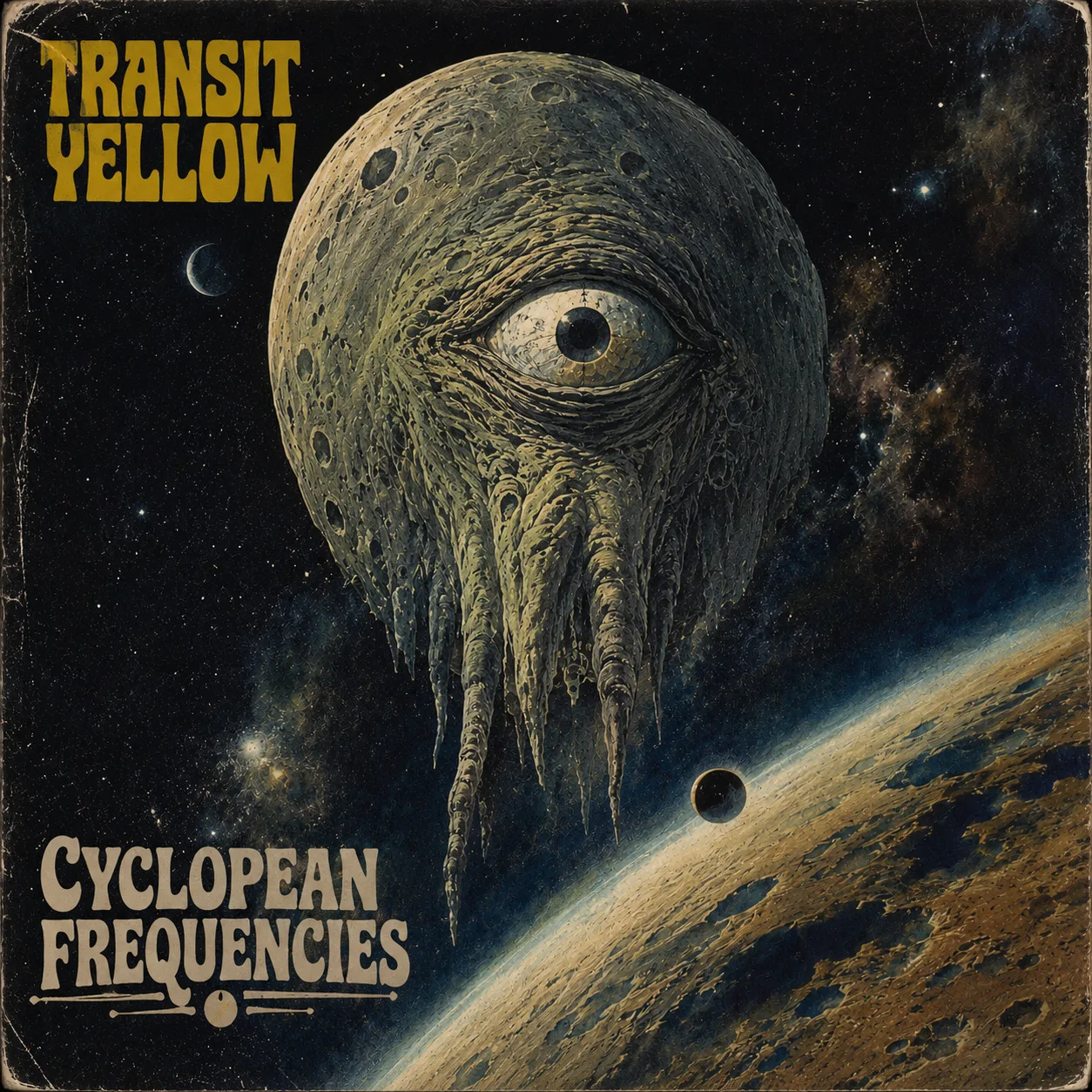
A cosmic horror doom setting of H.P. Lovecraft's "The Dreams in the Witch House" (1933). From the debut album Cyclopean Frequencies.
The Story
Lovecraft wrote "The Dreams in the Witch House" in January and February 1932. It first appeared in Weird Tales in July 1933. It is a mathematics-horror story, one of the few in his catalogue where the horror is not summoned by a book or a cult but calculated by a student on a blackboard.
Walter Gilman is a student of non-Euclidean geometry, folklore, and Miskatonic University's darker library holdings. To save money he takes an attic room in a run-down house in Arkham that has been avoided for two centuries. Two hundred years earlier the room had been rented by Keziah Mason, one of the accused of the Salem trials, who escaped her cell by drawing curves and angles on the wall in a substance that was not ink, and stepping into them.
Gilman's room has bad angles. The ceiling slopes at an incorrect pitch. Two walls meet at a corner that does not resolve. He begins to dream. In the dreams he moves through geometries that are not part of ordinary space, through folded surfaces, past prisms of impossible colour, into abysses that do not connect to his room but are approached from it.
He meets Keziah in the dreams. She is old, bent, and she speaks with the voice of an animal. She is accompanied by a small creature the size of a large rat, with the face of a bearded old man, called Brown Jenkin. Gilman learns that Keziah has been using the geometry of the room to travel between the world and other places since she escaped the gallows in 1692. The dreams are recruitment. She wants him to sign the black book.
The story ends in violence and in a cavity in the walls that a workman finds after Gilman is dead. It is a cache of small bones and stolen objects going back centuries, gathered by Brown Jenkin over the two hundred years the house has been standing.
The story is famous for taking Lovecraft's usual horror of non-Euclidean geometry, angles that do not add up, corners that lead elsewhere, and grounding it in a domestic space. A student's rented room. A slanted ceiling. A place any listener could imagine themselves lying awake in.
The Track
-
Minimalist by design
Violet Bleed is built around the horror at the heart of the story: the angles are wrong. The geometry of time and space is not right, and through the crookedness of a room whose corners will not meet, the outside seeps in. You are being watched from whatever is on the other side of that broken geometry.
The lyrics are deliberately minimalist. Space left for the music to breathe. A violet light bleeding to the street. Walls folding inward. Cosmic watchers falling upward through the deep. This song does not follow Brown Jenkin. He waits for a different track.
Lyrics
-
The angles in the corner do not meet
A violet light is bleeding to the street
The walls are folding inward on the floor
I hear the scratching just beyond the door
The geometry of sleep
Where the cosmic watchers creep
Falling upward through the deep
The geometry of sleep
Listen
Violet Bleed appears on the album Cyclopean Frequencies.
Other Tracks on Cyclopean Frequencies
-
Spin
Draws on H.P. Lovecraft's Azathoth. The blind idiot god at the centre of the cosmos, whose maddening piping keeps the universe turning. Read more →
-
Silver Cylinders Fly
Draws on H.P. Lovecraft's "The Whisperer in Darkness." The Mi-go: fungoid crustacean beings from Yuggoth who harvest human brains into gleaming metal cylinders for transport between worlds. Read more →
-
Alien Stone
Draws on H.P. Lovecraft's "The Colour Out of Space." A meteorite falls on a Massachusetts farm, and something not-quite-a-colour bleeds into the soil, the water, and everything living. Read more →
-
Transit Yellow
The title track. Draws on Robert W. Chambers's The King in Yellow. The play that drives its readers mad; the tattered king; the lost city of Carcosa. Read more →
-
Sarnath
Draws on H.P. Lovecraft's "The Doom That Came to Sarnath." A curse that arrived after the memory of what caused it was gone. Read more →
-
The Beast
Draws on H.P. Lovecraft's "The Outsider." The narrator who climbs from the tomb into a candlelit ballroom and sees, in a great mirror, what the guests are fleeing from. Read more →
-
Hound of Tindalos
Draws on Frank Belknap Long's "The Hounds of Tindalos," a foundational Cthulhu Mythos story of the entities that dwell in the angles of time and hunt through the smoothness of curves. Read more →