Transit Yellow
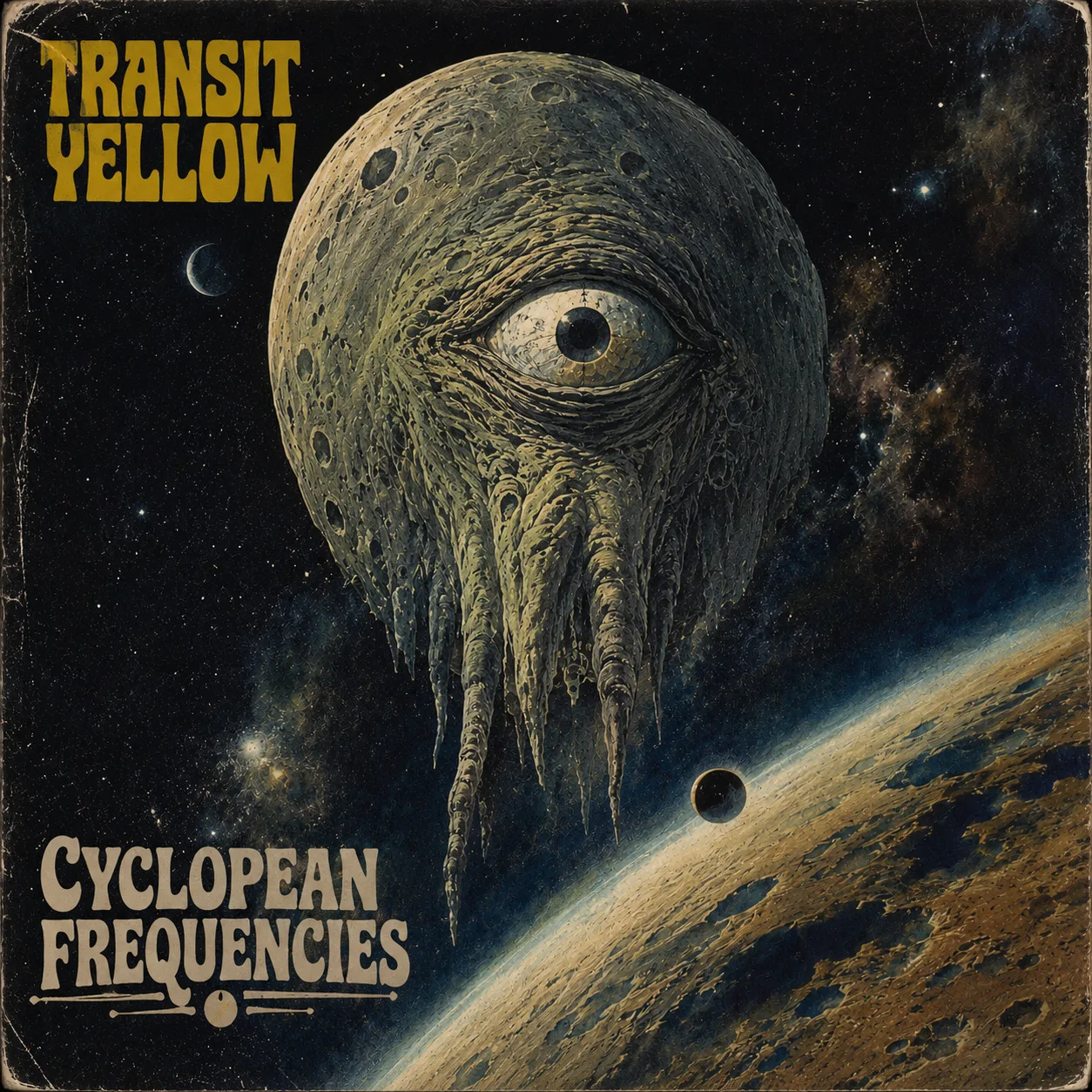
The title track. A cosmic horror doom setting of Robert W. Chambers's The King in Yellow (1895). From the debut album Cyclopean Frequencies.
The Story
Robert W. Chambers published The King in Yellow in 1895. It is a collection of loosely linked stories set in an unsettled Paris and an alternate near-future New York. The first four stories in the book share a device that would go on to shape twentieth-century weird fiction: a fictional play, also called The King in Yellow, whose second act drives every reader who finishes it to madness or ruin.
The play itself is never shown. Chambers quotes fragments: a stage direction, a line from a character called Cassilda, a chorus that ends the first act on the promise that the second is worse. Everyone who picks the book up says they will not read past Act I. Everyone who does read past Act I is destroyed by it.
The world of the play is Carcosa. There, twin suns sink into the Lake of Hali. There is a city called Yhtill and a ruined valley and a court where a figure in a tattered yellow mantle wears a pallid mask that is not, it turns out, a mask. His crown is real. His face is not there. He is the King in Yellow, sometimes named Hastur, and his sign, the Yellow Sign, is a mark that appears on those who have seen him and cannot un-see him.
Chambers's stories in the collection follow characters who have read the play, or who wear the sign, or who find themselves living the story it tells. "The Repairer of Reputations" is narrated by a man whose grip on reality has already gone. "The Mask" is a Parisian tragedy about a chemical that turns living tissue to marble. "In the Court of the Dragon" is a haunting in a church. "The Yellow Sign" is the ghost story that would influence Lovecraft, Bierce, and every weird writer who came after.
H.P. Lovecraft absorbed Chambers's material into his own mythology. Hastur, Carcosa, and the Yellow Sign appear across the Cthulhu Mythos, alongside references from August Derleth and others. The King in Yellow became a shared symbol: a work of art whose beauty is a lure, whose message is annihilation, and whose author is someone or something that never wanted the work read at all.
The Track
-
The Yellow Sign, and the band
Transit Yellow is the album's title track and the song that names the whole project. It follows the tattered king on his nightmare and destruction travels, through Carcosa, past the twin suns sinking into the Lake of Hali, along the ruined valley where the shadows lengthen and the shape without a face wears the crown. The curtain rises on the second act, which is where the play reaches into whoever is reading and does not let go.
The chorus is the destruction the king carries with him: the tattered mantle in the dying light, Cassilda weeping in the endless night, the sign appearing in the blackened sky, a beautiful way for the soul to die. Every witness bows. The song is sung by the walking dead.
At the end, the mask is torn off, and what stands underneath is Transit Yellow. The title track makes the band name the Yellow Sign itself: recognition, marking, the moment before the fall. Have you found the Yellow Sign? Have you found the Transit Yellow?
Lyrics
-
The curtain rises on the second act
A broken mind and a bloody pact
I read the words upon the yellow page
I built the Carcosa upon this stage
Take it off. Take it off.
You wear the mask but the face is lost.
The Twin Suns sink in the Lake of Hali!
The shadows lengthen in the ruined valley!
He wears no face but he wears the crown!
The Yellow King is coming to tear it down!
The tattered mantle in the dying light
Cassilda weeping in the endless night
We saw the sign in the blackened sky
A beautiful way for the soul to die
Bow your head. Bow your head.
The song is sung by the walking dead.
Have you found the Yellow Sign?
Have you found the Yellow Sign?
Have you found the Transit Yellow?
Listen
Transit Yellow appears on the album Cyclopean Frequencies.
Other Tracks on Cyclopean Frequencies
-
Spin
Draws on H.P. Lovecraft's Azathoth. The blind idiot god at the centre of the cosmos, whose maddening piping keeps the universe turning. Read more →
-
Silver Cylinders Fly
Draws on H.P. Lovecraft's "The Whisperer in Darkness." The Mi-go: fungoid crustacean beings from Yuggoth who harvest human brains into gleaming metal cylinders for transport between worlds. Read more →
-
Alien Stone
Draws on H.P. Lovecraft's "The Colour Out of Space." A meteorite falls on a Massachusetts farm, and something not-quite-a-colour bleeds into the soil, the water, and everything living. Read more →
-
Violet Bleed
Draws on H.P. Lovecraft's "The Dreams in the Witch House." Non-Euclidean geometry as a route between worlds. Read more →
-
Sarnath
Draws on H.P. Lovecraft's "The Doom That Came to Sarnath." A curse that arrived after the memory of what caused it was gone. Read more →
-
The Beast
Draws on H.P. Lovecraft's "The Outsider." The narrator who climbs from the tomb into a candlelit ballroom and sees, in a great mirror, what the guests are fleeing from. Read more →
-
Hound of Tindalos
Draws on Frank Belknap Long's "The Hounds of Tindalos," a foundational Cthulhu Mythos story of the entities that dwell in the angles of time and hunt through the smoothness of curves. Read more →