The Beast
A cosmic horror doom setting of H.P. Lovecraft's "The Outsider" (1921). From the debut album Cyclopean Frequencies.
The Story
Lovecraft wrote "The Outsider" in 1921 and it was first published in Weird Tales in April 1926. It is one of his most anthologised stories: short, first-person, and structurally closer to a Poe tale than to the cosmic horror Lovecraft would later be known for. But the trick of it is pure Lovecraft.
The narrator is a creature that has lived, as far as it can remember, alone in a lightless castle. It knows only endless stone corridors, cobwebs, decayed books, and its own reflection in stagnant water. A reflection it either cannot fully see or has learned not to look at. It has no memory of parents, of teachers, of any other living being. It does not know its own age. It does not know what it is.
It decides one day to climb. Above the ruined chambers of its home stands a black tower with no obvious way up. The narrator finds a ruined stairwell inside the tower and climbs it for what feels like an eternity, past cobwebs and dust and darkness, until at last it comes to a stone slab in the ceiling and pushes through.
It expects to emerge onto a high battlement of its castle. It emerges instead into a graveyard at ground level. The tower it climbed was buried underground. The world it thought it lived beneath is above it. There are stars overhead. There is a moon. It sees these things for the first time.
Following light, the narrator finds a lit castle nearby, walks in on a company of well-dressed people at a party, and is ecstatic to see other living beings at last. The people scream. They flee. Some of them faint. Some fall dead. In their panic, they abandon the great hall entirely.
The narrator, confused and hurt, sees at the far end of the hall the thing that has caused their terror: a hideous, rotting figure standing in an archway. It approaches, meaning to fight the monster and drive it out. It reaches to touch the creature's face. What it touches is cold glass. It has walked toward a mirror.
It is the beast. There is nowhere in the world of the living for it to be. It returns to the tomb. "For I am the outsider," it says, "a stranger in this century and among those who are still men."
The Track
-
Written almost as poetry
The Beast stays very close to the source and is written almost as poetry. A first-person account of a creature that has known only endless stones and shattered bone, no light, no sun, only the dark that swallowed it, and that climbs the ruined stairs of a black tower believing it might at last reach the world above. It pushes through the heavy slab, breaks the seal, and steps into a castle of golden light where living people scream and run.
It sees the monster in the hall. A hideous thing against the wall. It reaches out to touch the ghoul, and what it touches is cold glass. The mirror. The story turns on that single reveal: the creature that has climbed toward the light is the thing the people flee. It is the beast. And the only place left to go is back to the dark.
Lyrics
-
I know not where I was born
Endless stones and shattered bone
No light to see. No sun to bleed.
Just the dark that swallowed me.
Up the steps.
The ruined stairs.
The black tower rising in the air.
Cobwebs thick, the air is dead
A heavy slab above my head
I push the stone. I break the seal.
I touch a world that must be real.
The castle walls. The golden light.
The people screaming in the night.
They run from me.
They hide their eyes.
A sudden terror. A sudden prize.
I see the monster in the hall.
The hideous thing against the wall.
I reach my hand to touch the ghoul!
The rotting flesh! The nightmare fool!
Cold glass.
Cold glass.
I touched the mirror.
I am the beast.
Back to the dark.
Back to the dark.
Listen
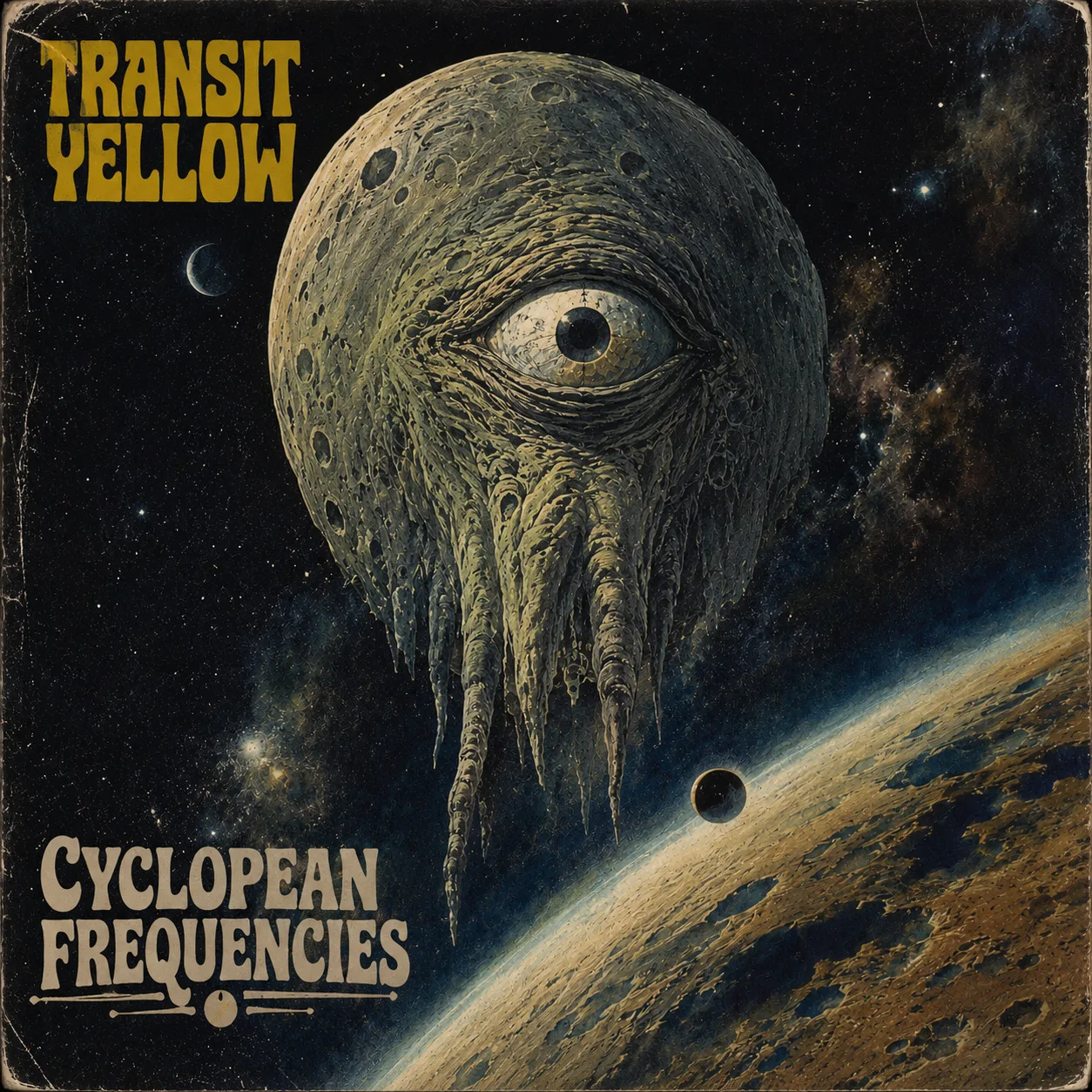
The Beast appears on the album Cyclopean Frequencies.
Other Tracks on Cyclopean Frequencies
-
Spin
Draws on H.P. Lovecraft's Azathoth. The blind idiot god at the centre of the cosmos, whose maddening piping keeps the universe turning. Read more →
-
Silver Cylinders Fly
Draws on H.P. Lovecraft's "The Whisperer in Darkness." The Mi-go: fungoid crustacean beings from Yuggoth who harvest human brains into gleaming metal cylinders for transport between worlds. Read more →
-
Alien Stone
Draws on H.P. Lovecraft's "The Colour Out of Space." A meteorite falls on a Massachusetts farm, and something not-quite-a-colour bleeds into the soil, the water, and everything living. Read more →
-
Transit Yellow
The title track. Draws on Robert W. Chambers's The King in Yellow. The play that drives its readers mad; the tattered king; the lost city of Carcosa. Read more →
-
Violet Bleed
Draws on H.P. Lovecraft's "The Dreams in the Witch House." Non-Euclidean geometry as a route between worlds. Read more →
-
Sarnath
Draws on H.P. Lovecraft's "The Doom That Came to Sarnath." A curse that arrived after the memory of what caused it was gone. Read more →
-
Hound of Tindalos
Draws on Frank Belknap Long's "The Hounds of Tindalos," a foundational Cthulhu Mythos story of the entities that dwell in the angles of time and hunt through the smoothness of curves. Read more →