Silver Cylinders Fly
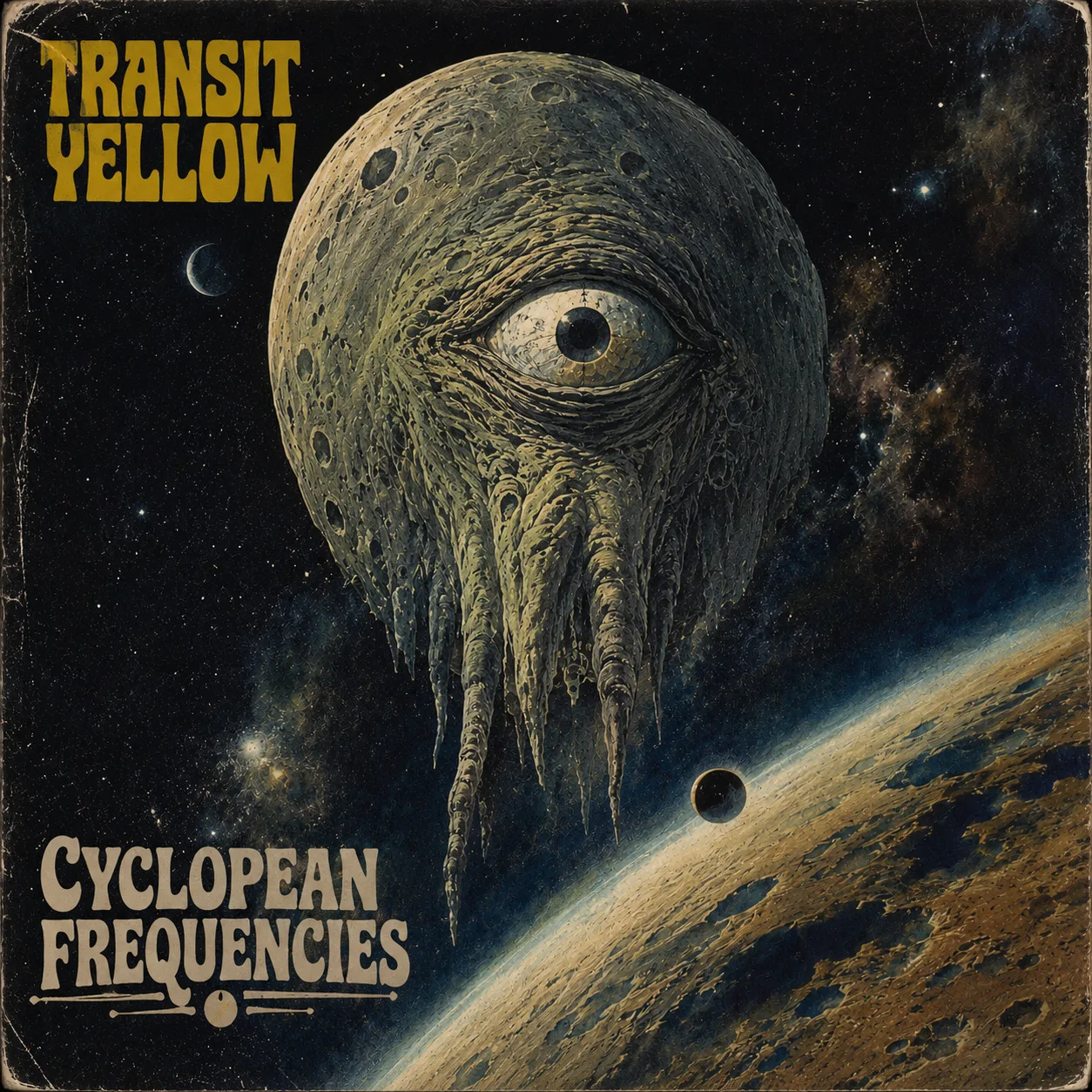
A cosmic horror doom setting of H.P. Lovecraft's "The Whisperer in Darkness" (1931). From the debut album Cyclopean Frequencies.
The Story
Lovecraft wrote "The Whisperer in Darkness" between February and September 1930 and first published it in Weird Tales in August 1931. It is one of his most fully realised Mythos stories. It is the one where the cosmic scale of what surrounds humanity is presented not as a nightmare glimpsed at the edge of vision but as a scientific correspondence conducted by post.
The narrator is Albert N. Wilmarth, a folklorist at Miskatonic University. Historic floods in Vermont wash strange bodies down the rural rivers. Things that are not fish, not animals, not any known form. Wilmarth defends the finds as folkloric hoaxes in the press, and receives a letter from a Vermont farmer named Henry Akeley who has been watching similar creatures in the hills above his home for years, and who has evidence.
The correspondence is the story. Akeley writes to Wilmarth about the Mi-Go: fungoid crustacean beings from Yuggoth, the outer planet that men call Pluto. They mine a rare ore in the Vermont hills. They can travel between worlds through the ether on their own wings. And they have been harvesting human brains. Extracting them surgically alive, sealing them into polished cylinders of a metal not found on Earth, and carrying them across interstellar dark to their home world and beyond.
The cylinders keep the brains conscious. They can be connected to speech and sensory apparatus and communicated with. They are shown the sights of other worlds. Akeley writes that this is what humanity has to look forward to. The Mi-Go consider it a favour.
When Wilmarth finally travels to Vermont to meet Akeley in person, he finds a man who is calmer than he should be, dressed strangely, seated in a shadowed chair, speaking in a whisper. The story ends with what Wilmarth sees in the empty room after his host has retired for the night.
The Mi-Go, Yuggoth, and the brain cylinders are among Lovecraft's most-referenced Mythos elements. The image of consciousness preserved indefinitely in a metal container, carried alive to worlds beyond the reach of any telescope, is one of the founding horrors of modern weird fiction.
The Track
-
Consciousness in transit
Silver Cylinders Fly is the harvest and the journey. The first verse is the transmission: static on the wire, voices in the hum, a star system beating like a drum. A pulsar glimpsed as the cylinders pass close. Shadows in the valley are the human bodies left behind. The chorus is the disintegration: fleshy shells failing, the mind fracturing under the weight of what it is being carried through, the architects of chaos leaving the galaxy destroyed.
The second verse is the source in the hills: fungus on the mountain, clicking in the dark, formulas in the brain that arrived as instruction, not as thought.
The outro is the promise the Mi-Go make and its horror made literal: brain in the jar, traveling far, past the last star. The brains are preserved. They are conscious. They are taken further than any human eye will ever see. And they never come home.
Lyrics
-
Static on the wire, voices in the hum
Calling from a star system, beating like a drum
Shadows in the valley, where the rivers run so cold
They speak of ancient orbits, and the secrets that they hold
And the mind begins to fracture, looking at the sky
Fleshy shells are failing, as the silver cylinders fly
We are nothing but a whisper, lost inside the void
While the architects of chaos leave the galaxy destroyed
Fungus on the mountain, clicking in the dark
Leaving behind the human, leaving behind the spark
Vibrations in the ether, formulas in the brain
Taking us across the black, driving us insane
Brain in the jar
Traveling far
Past the last star
Listen
Silver Cylinders Fly appears on the album Cyclopean Frequencies.
Other Tracks on Cyclopean Frequencies
-
Spin
Draws on H.P. Lovecraft's Azathoth. The blind idiot god at the centre of the cosmos, whose maddening piping keeps the universe turning. Read more →
-
Alien Stone
Draws on H.P. Lovecraft's "The Colour Out of Space." A meteorite falls on a Massachusetts farm, and something not-quite-a-colour bleeds into the soil, the water, and everything living. Read more →
-
Transit Yellow
The title track. Draws on Robert W. Chambers's The King in Yellow. The play that drives its readers mad; the tattered king; the lost city of Carcosa. Read more →
-
Violet Bleed
Draws on H.P. Lovecraft's "The Dreams in the Witch House." Non-Euclidean geometry as a route between worlds. Read more →
-
Sarnath
Draws on H.P. Lovecraft's "The Doom That Came to Sarnath." A curse that arrived after the memory of what caused it was gone. Read more →
-
The Beast
Draws on H.P. Lovecraft's "The Outsider." The narrator who climbs from the tomb into a candlelit ballroom and sees, in a great mirror, what the guests are fleeing from. Read more →
-
Hound of Tindalos
Draws on Frank Belknap Long's "The Hounds of Tindalos," a foundational Cthulhu Mythos story of the entities that dwell in the angles of time and hunt through the smoothness of curves. Read more →