Hound of Tindalos
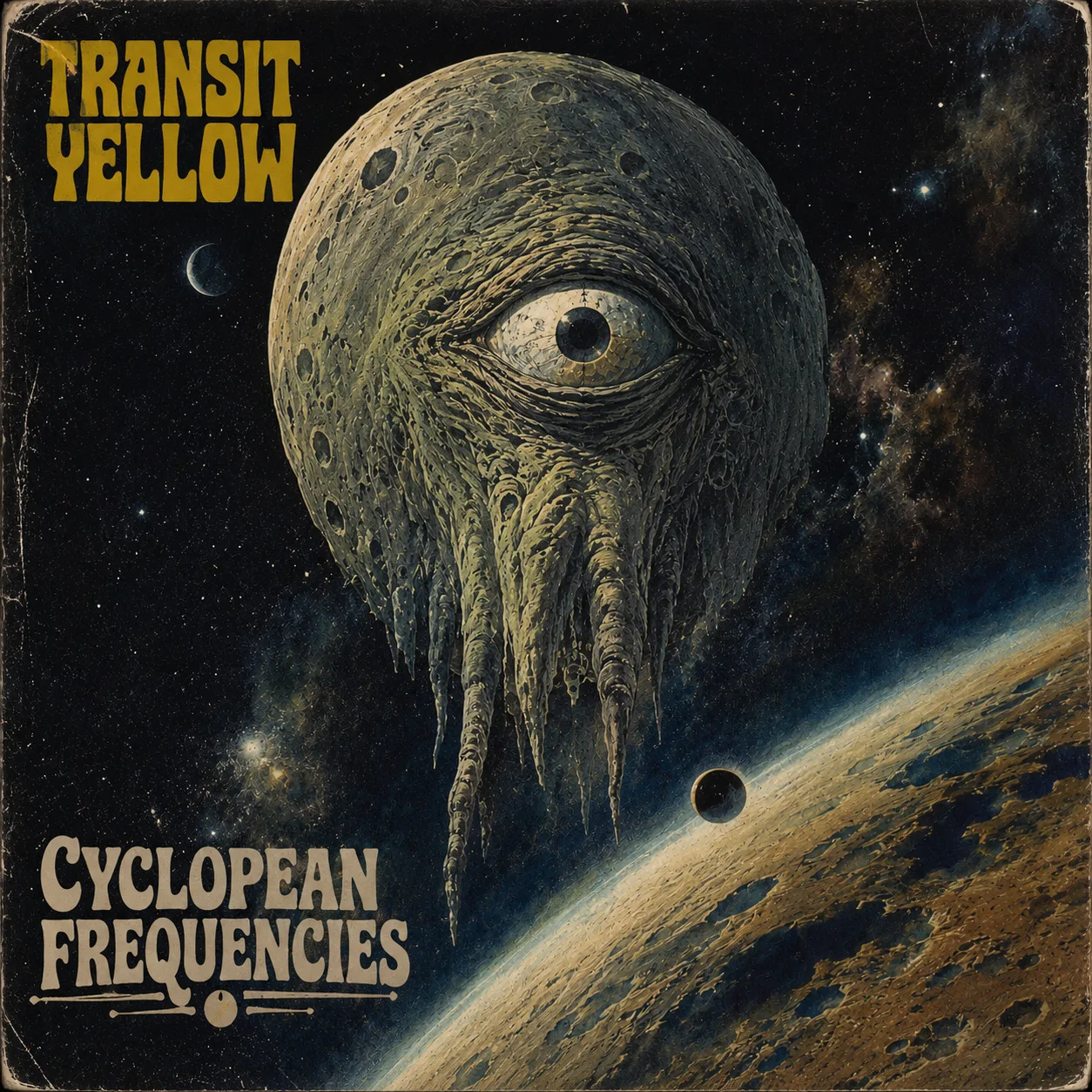
Inspired by Frank Belknap Long's classic The Hounds of Tindalos (Weird Tales, March 1929). From the debut album Cyclopean Frequencies.
The Story
Frank Belknap Long published "The Hounds of Tindalos" in Weird Tales in March 1929. Long was one of H.P. Lovecraft's closest friends and correspondents from the 1920s onwards, and the Hounds became one of the earliest additions to the shared Mythos by a writer other than Lovecraft himself. Lovecraft later referenced them in his own work.
The story is a first-person account by a man named Frank, who tells what happened to his friend Halpin Chalmers, an occultist and mystic living in a New York apartment. Chalmers is obsessed with reaching the deep past. Not centuries. Not millennia. All the way back, before the first cellular life, before the first molecule, before the substance of matter itself. He believes an ancient drug he has synthesised, together with mental discipline, can send his consciousness there.
Frank comes to Chalmers's apartment on the night of the attempt and stands watch while Chalmers takes the drug and enters a trance. What Chalmers reports, in fragments, is the vision of a landscape older than time. And the realisation that he is not alone in it. Something else lives at that depth. It has scented him. It is beginning to move toward him along the line he has cut back through time.
Chalmers gives the reader the rule that defines the Hounds. They inhabit only angles. They cannot exist in curves. If a surface is smooth, if a corner is rounded, they cannot pass. Life belongs to the curves. The Hounds belong to the sharp geometry that came before life, the angles at the beginning of things, and they hunt through the flaws in any space that has straight lines meeting.
Chalmers returns from the trance and knows he has been marked. He barricades himself into a single room. He orders builders to round every corner, fill every angle with plaster, sand every edge smooth. He works day and night on the geometry of his own apartment. Frank checks on him. The work is meticulous. Every angle is gone.
It does not save him. When Frank returns the following morning, Chalmers is dead. The state of the body, and of the room, is described in a police report the story ends by quoting. There is a residue on Chalmers where the Hound touched him. A substance not consistent with any known form of life.
The Hounds of Tindalos are one of the founding contributions to the wider Cthulhu Mythos. They introduced the idea that geometry itself can be a hunting ground. The shape of a room, or of time, or of space, can admit predators. Every non-Euclidean horror that came after owes something to Long's March 1929 story.
The Track
-
The angles do not quite connect
Another with minimal lyrics. The music does most of the work. A man reads an ancient book and practises the forbidden contents, and by doing so he alerts the Hound. The Hound approaches through the angles: the corners that do not quite connect, the geometry that should not admit a predator but does. As it closes on him, his sanity and the sanity of the music fracture and are lost.
The horror is that the rules he played with are older than the rules of the room he is standing in. He is not being hunted through space. He is being hunted through the shape of space.
Lyrics
-
The Hound, I hear the hound calling
Where the corners do not quite connect
I played with the rules
Now the hound comes to collect
The Hound, now he is here
Hidden In an angle not quite….right
My mind will break
As my body must be taken
Away
Credit
Inspired by Frank Belknap Long's classic The Hounds of Tindalos (Weird Tales, March 1929).
Listen
Hound of Tindalos appears on the album Cyclopean Frequencies.
Other Tracks on Cyclopean Frequencies
-
Spin
Draws on H.P. Lovecraft's Azathoth. The blind idiot god at the centre of the cosmos, whose maddening piping keeps the universe turning. Read more →
-
Silver Cylinders Fly
Draws on H.P. Lovecraft's "The Whisperer in Darkness." The Mi-go: fungoid crustacean beings from Yuggoth who harvest human brains into gleaming metal cylinders for transport between worlds. Read more →
-
Alien Stone
Draws on H.P. Lovecraft's "The Colour Out of Space." A meteorite falls on a Massachusetts farm, and something not-quite-a-colour bleeds into the soil, the water, and everything living. Read more →
-
Transit Yellow
The title track. Draws on Robert W. Chambers's The King in Yellow. The play that drives its readers mad; the tattered king; the lost city of Carcosa. Read more →
-
Violet Bleed
Draws on H.P. Lovecraft's "The Dreams in the Witch House." Non-Euclidean geometry as a route between worlds. Read more →
-
Sarnath
Draws on H.P. Lovecraft's "The Doom That Came to Sarnath." A curse that arrived after the memory of what caused it was gone. Read more →
-
The Beast
Draws on H.P. Lovecraft's "The Outsider." The narrator who climbs from the tomb into a candlelit ballroom and sees, in a great mirror, what the guests are fleeing from. Read more →